Outrigger 101
Outrigger canoeing comes from the Pacific, where Polynesian voyagers crossed open ocean in canoes balanced by a float on one side. We paddle that same design on Lake Michigan. Here's everything you need to step into the boat with confidence.
The basics
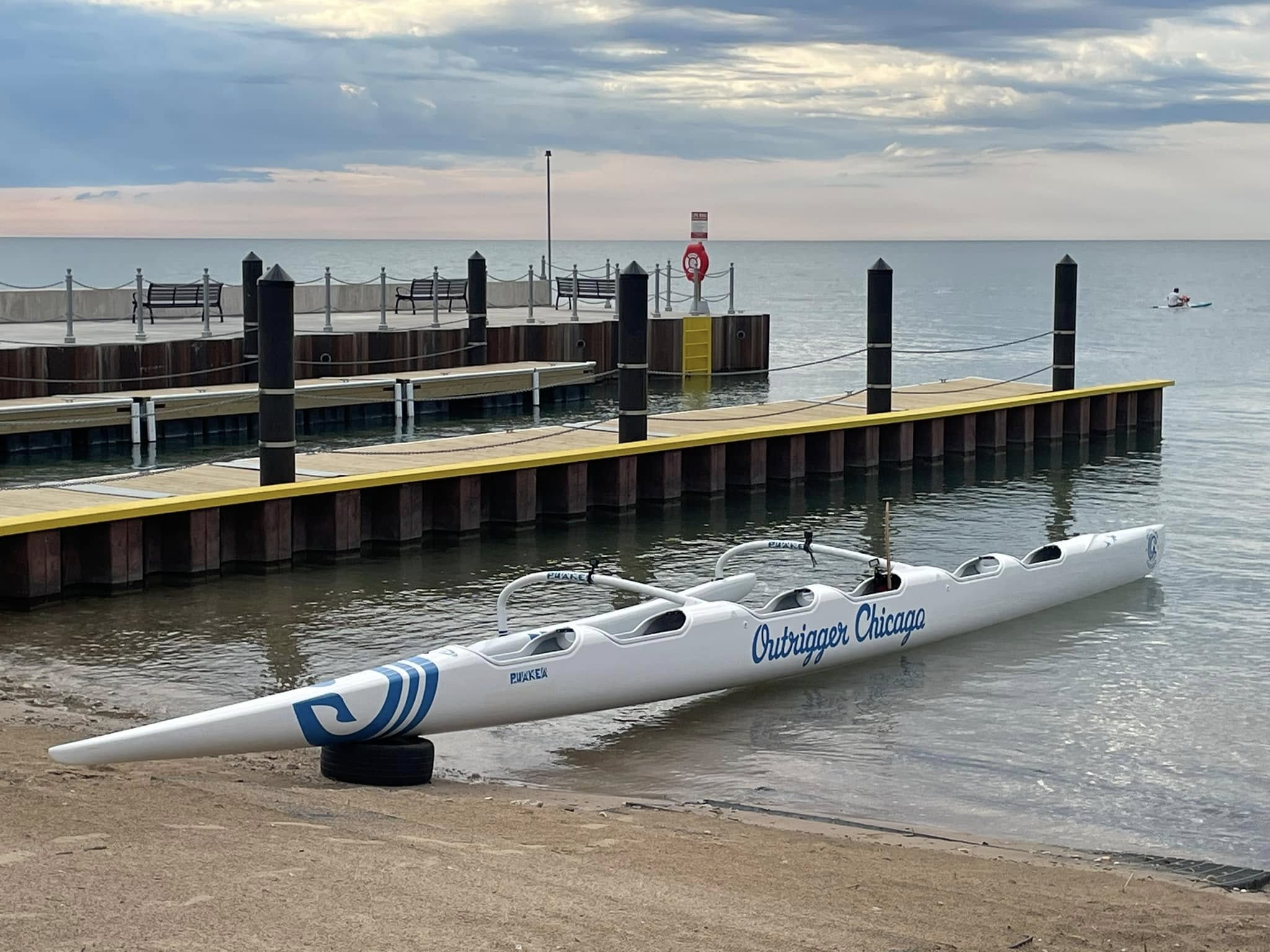
An outrigger canoe is a narrow hull with a buoyant float — the ama — attached to one side by two curved booms. The ama is what makes the canoe stable enough to power through open water and surf downwind swell.
The crew canoe is an OC6: six paddlers seated single file, switching sides in unison on a called cadence. Many paddlers also race solo in an OC1 or with a partner in an OC2. Outrigger Chicago owns three OC6s, and members bring their own OC1s and OC2s to the beach.
It's a team sport and a moving meditation at once: when six blades enter the water together, the canoe lifts and runs. That moment — the run — is why people get hooked.
Anatomy of the canoe
Outrigger keeps its Hawaiian vocabulary. You'll hear these words on the beach from day one.
The main body of the canoe that you sit in and paddle.
The buoyant outrigger that rides on the water's surface and keeps the canoe upright.
The two curved arms connecting the hull to the ama.
A single-blade paddle, usually bent-shaft, sized to your height and stroke.
When the canoe tips over. We practice the recovery so it's calm and quick, not scary.
"Forward / advance." The spirit of moving ahead together — and a common rallying call.
Inside the OC6
Each position has a role. You'll try several over time and find where you click.
Seats 1–2 own the timing, 3–5 are the power, and seat 6 steers and keeps the crew safe. The whole crew switches paddling sides together on the call — usually every 12–15 strokes.
The stroke
Rotate from the torso and plant the blade well forward — the catch happens up by your feet, not at your hip.
Drop the full blade in cleanly. No splash, no air — just a quiet, complete grip on the water.
Hang your weight on the blade and unwind your core, then pop the paddle out at the hip before it drags.
Match seat 1 exactly. Six blades entering as one is what makes the canoe surge — power without timing just wobbles the boat.
A friendly intro on the beach, a quick safety brief, then real paddling on the lake. You won't be alone — an experienced crew surrounds every newcomer.
Clothes that can get wet, a secured water bottle, sun protection, and a full change of clothes for after. We provide the canoe, paddles, and PFDs (as needed).
If you can swim and you're up for getting wet, you can paddle. No prior experience needed — many of our strongest paddlers started with zero.
Respect the lake
Great Lakes water stays cold well into summer, and conditions change fast. Safety isn't a buzzkill here — it's what lets us go out and have fun.
Reading about it only gets you so far. The catch, the timing, the lift of the canoe — that part you have to paddle.